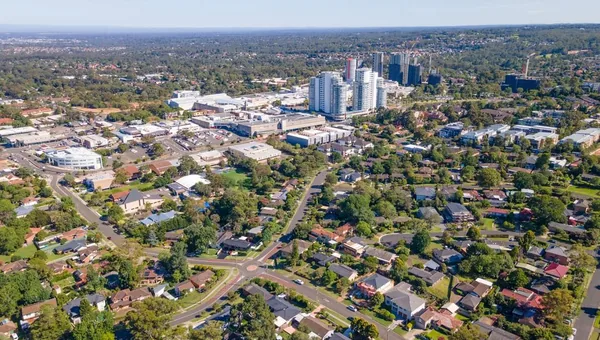
Castle Hill (2154) sits approximately 30 kilometres north-west of the Sydney CBD in the Hills District, governed primarily by The Hills Shire Council. Its SEIFA IRSAD score of 1124 places it in the national top decile (decile 10 of 10) and at the 89th percentile within New South Wales, meaning the suburb ranks among the most socioeconomically advantaged postcodes in the country. That reading reflects a population with above-average household incomes, high rates of home ownership, and strong educational attainment. For investors, it sets a clear macro context: this is not a distressed or transitional market.
ABS 2021 IRSAD release. Score 1124 (national mean = 1000).
A SEIFA IRSAD score of 1124 sits 124 points above the national mean of 1000. In PropertyRanker's twelve-signal model, this reading feeds directly into three criteria: economic_strength, hazard_risk, and entry_point_risk. On economic_strength, the score signals a resident base with durable income capacity, which supports rental demand from professional households and limits the risk of prolonged vacancy during softer cycles. On hazard_risk, high-SEIFA suburbs tend to correlate with better-maintained infrastructure and lower exposure to socioeconomic stress events, though this is a probabilistic relationship, not a guarantee for any individual property. On entry_point_risk, the same score cuts the other way: a top-decile suburb in a major capital city typically carries a premium price-to-income ratio, compressing gross yields and raising the bar for cash-flow-positive outcomes.
Castle Hill's Metro Northwest connectivity, its role as the commercial and retail centre of the Hills District, and its established school network all reinforce the macro signal. However, the suburb contains a genuine mix of dwelling types, from large freestanding homes on generous lots through to newer apartment stock near the Castle Hill and Hills Showground metro stations. Yield profiles vary considerably across that spectrum. Investors targeting PropertyRanker's Capital Growth strategy (gross yield anchor around 3.5 percent) will find the macro frame broadly supportive. Those running a High Yield or Regional strategy (anchors of 6 to 7 percent) should expect the postcode-level SEIFA reading to work against them on pricing, and will need to identify specific listings where the yield arithmetic still closes. A strong SEIFA score does not make every listing in 2154 a buy, and a weak individual property inside this postcode can still score poorly once strata health, vacancy, and comparable sales are factored in.
Castle Hill NSW 2154 recorded a median house sale price of approximately $2.5 million over the past 12 months, representing annual growth of around 3.5%, according to propertyvalue.com.au. openagent.com.au (September 2026) corroborates modest house price growth of 2.9% over 12 months, while aussie.com.au reports a higher 10% growth figure, reflecting variation across aggregator methodologies. With 469 houses sold in the past 12 months, an average vendor discount of -5.2%, and average days on market of 37, the market is transacting at a measured pace with vendors still conceding some ground on price.
Anchor points pulled per refresh from publicly available suburb profiles. Approximate; not a moving average.
Rental vacancy is tightening (house rents up 6.7% per openagent.com.au) but days on market and vendor discounting show no clear directional shift, producing a mixed steady reading.
Sources: Castle Hill NSW 2154 House Prices and Property Trends - propertyvalue.com.au (2026-09-01); Castle Hill Property Market and Trends - openagent.com.au (2026-09-01); Castle Hill NSW 2154 Suburb Profile - view.com.au (2026-07-01); Castle Hill 2154 NSW Property Market and Insights - aussie.com.au (2026-09-01); Castle Hill NSW 2154 Suburb Profile - yourinvestmentpropertymag.com.au (2026-07-01) · Refreshed 7 Oct 2026
PropertyRanker scores any Australian property against 12 criteria across three pillars: Growth, Cashflow, and Risk. SEIFA is a primary signal for economic strength and a supporting one for entry-price risk. It also informs the crime side of hazard risk, though physical overlays like flood, bushfire and coastal exposure, and recorded crime data where available, take priority there. The decile of 10 shown above gives a listing in Castle Hill a stronger starting line on economic strength than the national median postcode, and a softer one on entry-price risk, since more advantaged postcodes usually carry higher entry prices.
On top of that, PropertyRanker chooses one of four strategies (Balanced, Growth, Yield, Regional) and applies a per-strategy yield anchor. The anchors are 3.5% for Growth, 5% for Balanced, 6% for Yield, and 7% for Regional. A postcode at this level of relative advantage tends to suit the Growth (3.5% anchor) and Balanced (5% anchor) strategies more readily than Yield (6%) or Regional (7%), because a higher entry price compresses the gross yield a listing can reach without a specific value-add.
Read the scoring guide for the full criteria list and how the verdict thresholds work.
Before acting on the macro signal, investors should confirm several things that a postcode-level SEIFA reading cannot see. First, check current SQM Research vacancy data for 2154: even high-SEIFA suburbs can experience localised oversupply, particularly in the apartment segment near the metro stations. Second, for any strata title, obtain the owners corporation records and confirm the administrative fund and sinking fund are adequately capitalised; a poorly managed body corporate in a premium suburb carries real financial risk. Third, run a flood and planning overlay check through the NSW Spatial Viewer and The Hills Shire Council's mapping tools, as pockets of Castle Hill adjoin creek corridors and bushland reserves that may carry overlay constraints. Fourth, price the specific listing against recent comparable sales in the same street or complex, not suburb-wide medians, because the spread between a renovated house on a large lot and a compact metro-adjacent unit is substantial. Score the specific listing in PropertyRanker to get a verdict that accounts for all twelve signals, including current SQM vacancy, body corporate health, flood and overlay status, and pricing against recent comparable sales.
The macro signals are supportive for certain strategies but carry a specific trade-off. Castle Hill's SEIFA IRSAD score of 1124 places it in the national top decile, reflecting a resident base with durable income capacity and strong educational attainment, which PropertyRanker reads as a positive for economic_strength and rental demand stability. The same score, however, flags elevated entry_point_risk, because a top-decile suburb in greater Sydney typically carries a premium price-to-income ratio that compresses gross yields. The data sets a context; it does not make every listing in 2154 a sound investment, and scoring the specific property remains essential.
Castle Hill's SEIFA reading and its role as the established commercial centre of the Hills District align most naturally with PropertyRanker's Capital Growth strategy, which anchors around a 3.5 percent gross yield and prioritises economic strength over cash flow. Investors running a High Yield or Regional strategy, with gross yield anchors of 6 to 7 percent, will find the postcode's premium pricing works against closing that yield arithmetic on most listings. That said, the suburb contains a genuine mix of dwelling types, from large freestanding homes through to newer apartment stock near the Castle Hill and Hills Showground metro stations, so yield profiles vary; a Balanced strategy at around 5 percent may be achievable on specific listings and warrants checking against live data.
Entry_point_risk is the most structurally prominent flag: a SEIFA decile-10 suburb in North-West Sydney tends to be priced at a premium, meaning the margin for error on purchase price is narrower. The Hills Shire LGA also sits within the broader Hawkesbury-Nepean catchment area, which has documented flood history, so hazard_risk is not zero and individual property position within the suburb matters; investors should verify specific flood overlays with The Hills Shire Council before relying on the postcode-level SEIFA signal alone. For apartment stock near the metro stations, strata health and vacancy data are additional variables that can override a strong suburb-level score.
Castle Hill is served by two Sydney Metro Northwest stations, Castle Hill and Hills Showground, both part of the Metro North West and Bankstown Line that opened in 2019, providing rail access toward the Sydney CBD. PropertyRanker treats established transport infrastructure as a supporting factor within its economic_strength signal, because proximity to rapid transit broadens the pool of professional renters who can commute without a car. This is a qualitative reinforcement of the SEIFA reading rather than a standalone score input, and its weight on any specific listing depends on actual walking distance to the station, not just the suburb name.
SEIFA feeds into three of PropertyRanker's twelve scoring criteria: economic_strength, hazard_risk, and entry_point_risk. The remaining nine signals are assessed at the listing or street level and include factors such as strata health (for units), comparable sales, vacancy indicators, and dwelling-type characteristics. A strong suburb SEIFA score lifts the floor on those three criteria but cannot offset a weak result across the other nine, which is why two properties within postcode 2154 can score very differently from each other. Investors should run the full twelve-signal score on any specific listing rather than relying on the suburb-level SEIFA figure alone.
Paste a real address. Get a defensible verdict across 12 criteria in around three minutes.
Score a property free