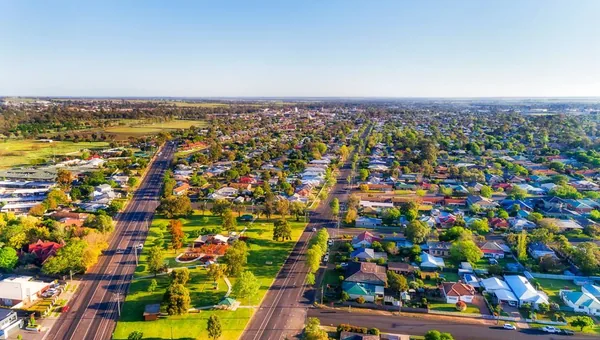
Dubbo sits in central New South Wales roughly 400 km north-west of Sydney, in postcode 2830. The reading is SEIFA decile 5 at IRSAD 967, in the 44th state percentile within New South Wales.
ABS 2021 IRSAD release. Score 967 (national mean = 1000).
Decile 5 is a mid-band reading. The 967 IRSAD score sits below the national mean, and the 44th state percentile reflects a regional centre rather than a metropolitan postcode. Dubbo is the largest regional centre in the NSW central west, and the postcode contains a CBD, a meaningful health and education employment base, and a broad mix of residential stock. PropertyRanker uses SEIFA as a primary signal for economic_strength, hazard_risk, and entry_point_risk. A decile 5 reading places Dubbo close to the national median on those three criteria. What sets Dubbo apart structurally is the diversity of the underlying economy. Health (Dubbo Base Hospital), education (TAFE and Charles Sturt presence), agriculture, and transport-logistics all contribute, which gives the suburb a more durable demand profile than single-industry regional centres. The strategy match for 2830 typically leans Yield or Regional. The Regional strategy's 7% gross-yield anchor is reachable on a narrower share of stock, and the Yield anchor of 6% is meet-able on most older detached housing. The risk read is that regional NSW yields are real but the management overhead at distance from any larger city is non-trivial.
Dubbo's house market is recording strong momentum, with CoreLogic data (via yourinvestmentpropertymag.com.au) showing a median house price of $665,000 and annual capital growth of 12.71% in the 12 months to May 2026, well above the national average. propertyvalue.com.au (Cotality) reports 997 house sales over the past 12 months at a median of $630,000, with an average vendor discount of -4.5% and 31 days on market. Inventory has tightened sharply from 3.6 months in mid-2024 to under 2 months by mid-2026 according to investorkit.com.au, pointing to sustained upward price pressure.
Anchor points pulled per refresh from publicly available suburb profiles. Approximate; not a moving average.
Inventory has fallen sharply from 3.6 to under 2 months and days on market are low at 28-31 days, with vendor discounts holding steady at -4.5%, giving two of three tightening signals.
Sources: Dubbo, NSW 2830: Suburb Profile & Property Report | YIP (CoreLogic data) (2026-08-30); Dubbo House Prices & Property Trends | propertyvalue.com.au (2026-01-01); Dubbo Property Market in 10 Charts | investorkit.com.au (2026-06-18); Suburb Report Dubbo NSW 2830 (CoreLogic, 24 March 2025) | dubbo.nsw.gov.au (2025-03-24); Dubbo house prices hold on lower sales volume | bobberry.com.au (2024-08-01) · Refreshed 14 Sep 2026
Dubbo's property story over the past year has been shaped by major infrastructure delivery, notably the new Newell Highway bridge, alongside a wave of residential and retail development in the growing south and west of the town. Council report a steady pipeline of dwelling approvals and multi-million dollar development applications, while the region's renewable energy zone status is driving related training and utility infrastructure investment. These drivers point to an area actively expanding its housing stock and commercial base rather than one experiencing dramatic price shifts alone.
The Australian and NSW governments are investing $263.2 million in the new bridge over the Macquarie River, which is expected to provide flood resilience and unlock land for an estimated 5,500 homes; the project is due to finish in late 2026.
The Village Southlakes, anchored by Coles and Liquorland at Stream Avenue and Boundary Road, is set to open in July 2026, and developer MAAS Properties has since lodged a $39 million development application for 104 dwellings, including duplexes and detached homes, on adjoining land in South Dubbo.
Daily Liberal (2026-06-23)
A Dubbo Regional Council report noted 95 development applications under assessment, including a 90 lot subdivision on Champagne Drive valued at $6.0 million and a 203 lot subdivision on Narromine Road valued at $15.0 million in West Dubbo, plus commercial and renewable energy proposals.
Daily Liberal (2026-06-13)
Dubbo Regional Council purchased a Wellington site for the Renewable Energy Awareness and Career Training (REACT) Centre, backed by an $11.24 million EnergyCo grant tied to the Central-West Orana Renewable Energy Zone, with the facility expected to open by 2028; this is a Wellington-based project within the wider Dubbo Region LGA.
Dubbo Regional Council (2026-04-15)
Under the NSW Government's Key Health Worker Accommodation program, 30 one-bedroom staff units are planned for the Dubbo Hospital campus, with construction expected from early to mid 2026 through to the second quarter of 2027.
Dubbo Regional Council allocated $20.8 million to a Wiradjuri Tourism Centre and funded projects including the Old Dubbo Road bridge upgrade at Eulomogo Creek and a floodway upgrade on Saxa Road, part of the LGA-wide capital works program for 2026-27.
Updated 4 Jul 2026. Items link to their original sources. Compiled by AI from public reporting; verify anything material before relying on it.
PropertyRanker scores any Australian property against 12 criteria across three pillars: Growth, Cashflow, and Risk. SEIFA is a primary signal for economic strength and a supporting one for entry-price risk. It also informs the crime side of hazard risk, though physical overlays like flood, bushfire and coastal exposure, and recorded crime data where available, take priority there. The decile of 5 shown above gives a listing in Dubbo a broadly mid-band starting line on economic strength and entry-price risk relative to the national median postcode.
On top of that, PropertyRanker chooses one of four strategies (Balanced, Growth, Yield, Regional) and applies a per-strategy yield anchor. The anchors are 3.5% for Growth, 5% for Balanced, 6% for Yield, and 7% for Regional. A mid-band postcode does not favour one strategy outright; Balanced (5% anchor) is the common fit, with Yield (6%) reachable where a specific listing rent-to-price ratio supports it.
Read the scoring guide for the full criteria list and how the verdict thresholds work.
Dubbo's housing varies sharply by neighbourhood, and SEIFA cannot tell you which side of the city a listing sits, the actual proximity to the hospital and education precincts, or the flood overlay status along the Macquarie River. Insurance pricing in regional NSW has been rising, and the realistic-yield calculation needs to factor that in. Score the listing in PropertyRanker for a verdict that accounts for these.
The SEIFA IRSAD reading of 967 places Dubbo at decile 5 nationally and the 44th state percentile within New South Wales, reflecting a regional centre rather than a metropolitan market. What distinguishes it from simpler regional towns is the breadth of the employment base: Dubbo Hospital operates as a major rural referral facility serving a large catchment across western NSW, sitting alongside education, agriculture, and transport-logistics sectors. That diversity tends to produce a more durable rental demand profile than single-industry towns at a similar SEIFA level. PropertyRanker scores each listing individually, so the tool is the appropriate place to verify how a specific property translates that structural picture into a score.
The data profile for postcode 2830 typically aligns with the High Yield strategy (around a 6 percent gross-yield anchor) or the Regional strategy (around 7 percent), rather than Capital Growth or Balanced. Older detached housing in the suburb has historically been the stock most likely to meet the 6 percent anchor, while the 7 percent Regional threshold is reachable on a narrower share of listings. Score a specific listing on PropertyRanker to see which strategy threshold it clears, because the gap between individual properties on yield can be significant within a single postcode.
Three risks stand out for 2830. First, the IRSAD score of 967 sits below the national mean of 1000, which registers as a modest drag on PropertyRanker's economic_strength criterion. Second, Dubbo is situated on the Macquarie River and flood studies have identified parts of the town as having meaningful flood exposure, a factor that feeds directly into PropertyRanker's hazard_risk criterion; investors should check the specific flood overlay for any property before proceeding. Third, the management overhead of a regional asset held at distance from a major city is non-trivial and is not fully captured by any automated score, so factoring in property management costs is essential.
PropertyRanker applies the SEIFA IRSAD reading as a primary signal across three of its twelve scoring criteria: economic_strength, hazard_risk, and entry_point_risk. A decile 5 reading places Dubbo close to the national median on all three, meaning it neither receives a strong uplift nor a heavy penalty from the SEIFA component alone. The remaining nine criteria draw on listing-level data such as land size, build type, and comparable sales, so the final score for any property in 2830 will reflect considerably more than the suburb-wide SEIFA figure.
Flood exposure in Dubbo is not uniform across postcode 2830. The town sits on the Macquarie River and formal flood studies have identified specific floodplain areas, particularly around the river corridor, as carrying higher inundation risk, while properties on higher ground carry materially less exposure. PropertyRanker's hazard_risk criterion incorporates the suburb-level SEIFA signal as a proxy, but property-level flood overlay maps published by Dubbo Regional Council and the NSW SES are the appropriate tools to verify the risk for an individual address. Investors should treat that property-level check as non-negotiable before relying on any suburb-wide score.
Paste a real address. Get a defensible verdict across 12 criteria in around three minutes.
Score a property free