Glenmore Park sits in western Sydney inside postcode 2745, within Penrith City. The reading is SEIFA decile 9 at IRSAD 1055, in the 73rd state percentile within New South Wales.
ABS 2021 IRSAD release. Score 1055 (national mean = 1000).
Decile 9 is a strong reading, and the 1055 IRSAD score sits comfortably above the national mean of 1000. Glenmore Park has been one of western Sydney's more established advantaged-band suburbs for years, with a stock profile that leans heavily on owner-occupied family housing in master-planned releases dating from the mid-1990s onward. PropertyRanker uses SEIFA as a primary signal for economic_strength, hazard_risk, and entry_point_risk. A decile 9 reading lifts the score on those three criteria meaningfully, and the entry_point_risk reading benefits from a postcode that has held its SEIFA band consistently across two property cycles. The strategy match for 2745 typically leans Growth or Balanced. The Yield strategy's 6% gross-yield anchor is rarely reachable in this postcode, since the price-to-rent ratio reflects the suburb's owner-occupier-heavy demographic. The interesting question for any Glenmore Park listing is whether the suburb's relative-advantage premium is sustainable as the wider western Sydney corridor matures, and that is a long-cycle question rather than a SEIFA reading.
Glenmore Park's house market is recording a median sale price of $1,300,000 as of mid-2026, up 7.1% over the prior 12 months, with 335 sales transacted and an average vendor discount of -3.0%, according to propertyvalue.com.au. YIP (CoreLogic data, to May 2026) corroborates 326 house sales and 5.04% annual price growth, while HtAG Analytics reports stock on market of just 0.25% and inventory of 1.68 months, well below the balanced-market threshold of three months. Days on market of 12-14 days and a vacancy rate of 1.43% point to tight supply conditions, placing the suburb in a warming market band.
Anchor points pulled per refresh from publicly available suburb profiles. Approximate; not a moving average.
Days on market of 12-14 days and vendor discounts of -3.0% alongside stock on market of 0.25% indicate a fast-moving, supply-constrained market with two of three directional signals favouring sellers.
Sources: Glenmore Park House Prices & Property Trends (2026-01-01); Glenmore Park, NSW 2745: Suburb Profile & Property Report | YIP (2026-09-02); Glenmore Park, NSW 2745 Property Market and House Prices 2026 (2026-08-02); Glenmore Park Property Market Update 1st Half 2024 (2024-06-01); Glenmore Park NSW 2745 | Established Suburb in Penrith (2026-05-19) · Refreshed 29 Sep 2026
PropertyRanker scores any Australian property against 12 criteria across three pillars: Growth, Cashflow, and Risk. SEIFA is a primary signal for economic strength and a supporting one for entry-price risk. It also informs the crime side of hazard risk, though physical overlays like flood, bushfire and coastal exposure, and recorded crime data where available, take priority there. The decile of 9 shown above gives a listing in Glenmore Park a stronger starting line on economic strength than the national median postcode, and a softer one on entry-price risk, since more advantaged postcodes usually carry higher entry prices.
On top of that, PropertyRanker chooses one of four strategies (Balanced, Growth, Yield, Regional) and applies a per-strategy yield anchor. The anchors are 3.5% for Growth, 5% for Balanced, 6% for Yield, and 7% for Regional. A postcode at this level of relative advantage tends to suit the Growth (3.5% anchor) and Balanced (5% anchor) strategies more readily than Yield (6%) or Regional (7%), because a higher entry price compresses the gross yield a listing can reach without a specific value-add.
Read the scoring guide for the full criteria list and how the verdict thresholds work.
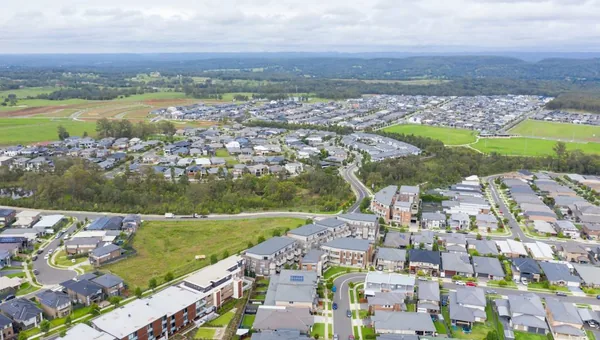
Glenmore Park's stock varies by release date. SEIFA cannot tell you the difference between an early-1990s release and a late-2000s one, the body corporate health on any townhouse purchase, or the bushfire-overlay status on streets backing onto the Nepean River or the Mulgoa Nature Reserve. The Penrith-region weather patterns mean some streets see seasonal hail and storm exposure. Score the listing in PropertyRanker for a verdict that accounts for these.
A SEIFA IRSAD score of 1055, sitting 55 points above the national mean and at the 73rd state percentile within New South Wales, signals a genuinely advantaged postcode that PropertyRanker rates positively on economic_strength, hazard_risk, and entry_point_risk. The suburb's master-planned stock, established since the mid-1990s, has held its advantaged-band classification across two property cycles, which reinforces the entry_point_risk score rather than inflating it. That consistency is a meaningful data point, but it describes the postcode's socioeconomic character rather than guaranteeing any particular return; investors should score the specific listing to see how individual property attributes interact with the suburb-level signals.
The data profile for postcode 2745 tends to align with the Capital Growth strategy (gross-yield anchor around 3.5 percent) or the Balanced strategy (anchor around 5 percent), because the suburb's owner-occupier-heavy demographic supports a price-to-rent ratio that makes the High Yield strategy's 6 percent anchor difficult to reach. The Regional strategy at around 7 percent gross yield is not a natural fit for a western Sydney suburb sitting at SEIFA decile 9, where relative-advantage premiums are already priced into stock. Run the specific listing through PropertyRanker to confirm which strategy band the actual numbers support, as individual properties can vary considerably within a postcode.
The most significant analytical risk is concentration: the suburb's stock skews heavily toward owner-occupied family housing in a master-planned format, which limits rental-demand diversity and makes gross yields more sensitive to price movements than to rental demand shifts. Glenmore Park does not have its own train station; residents rely on bus connections to Penrith Station for rail access, and the suburb is about 54 kilometres west of Sydney's CBD, meaning tenant demand is tied to car ownership and road infrastructure. A longer-cycle question the analysis flags is whether the relative-advantage premium that underpins the decile 9 reading remains durable as the broader western Sydney corridor matures around it, which is something to monitor across reporting periods rather than assume.
PropertyRanker applies SEIFA as a primary signal for three of its twelve scoring criteria: economic_strength, hazard_risk, and entry_point_risk, and the decile 9 reading lifts all three for postcode 2745. The remaining nine criteria draw on listing-level inputs including property type, asking price, and estimated yield, as well as council-level data from Penrith City Council and postcode-level signals around stock composition and infrastructure access. Investors should score the specific listing rather than rely solely on the suburb-level SEIFA band, because two properties on the same street can produce materially different scores depending on their individual attributes.
Council-level data feeds into several scoring inputs, and Penrith City Council's planning and infrastructure context is relevant because Glenmore Park sits on the southern fringe of Penrith and has been subject to ongoing road investment through the Western Sydney Infrastructure Plan. The suburb also sits within a catchment area where Penrith City Council has commissioned flood studies for nearby creek systems, so hazard_risk inputs for individual parcels should be verified against the council's flood planning maps rather than assumed to be uniform across the postcode. PropertyRanker uses these layers alongside the SEIFA reading; the composite score for a specific listing will reflect how those council-level hazard and planning factors apply to that parcel specifically.
Paste a real address. Get a defensible verdict across 12 criteria in around three minutes.
Score a property free