Hoppers Crossing sits in Melbourne's western corridor, in postcode 3029, alongside Truganina and Tarneit. The combined postcode reads SEIFA decile 6 at IRSAD 994, in the 52nd state percentile within Victoria.
ABS 2021 IRSAD release. Score 994 (national mean = 1000).
Decile 6 is a mid-band reading, just below the national mean of 1000. Hoppers Crossing is the longer-established suburb in 3029, with detached housing dating back several decades, while Truganina and Tarneit represent the master-planned-growth expansion of the same postcode. The SEIFA reading is therefore a blended average rather than a Hoppers-Crossing-specific signal. PropertyRanker uses SEIFA as a primary signal for economic_strength, hazard_risk, and entry_point_risk. A decile 6 reading places 3029 near the middle of the model on those three criteria. What separates Hoppers Crossing from the rest of the postcode in practice is the suburb's stock vintage. The detached housing in Hoppers Crossing is older, often three- or four-bedroom, and sits closer to established services than the master-planned estates further west in the postcode. The strategy match for 3029 typically leans Balanced. The Yield strategy's 6% gross-yield anchor is occasionally reachable on older detached stock in Hoppers Crossing, but the default fit is the rent-to-price ratio that supports a Balanced strategy. The interesting question for any 3029 listing is whether the suburb-level character (older vs. master-planned) is correctly priced against the postcode-wide growth narrative.
Hoppers Crossing houses recorded a median sale price of approximately $700,000 as at June 2026, reflecting 10.64% growth over the prior 12 months according to yourinvestmentpropertymag.com.au, with 640 house sales transacted in that period. propertyvalue.com.au reports an average vendor discount of -3.5% and average days on market of 24 days, while woodards.com.au notes days on market fell 17.2% year-on-year, pointing to strengthening buyer competition. Barry Plant and aupropertyreport.com.au historical data show the all-residential median has risen steadily from around $530,750 in 2022 to $705,000 by mid-2026.
Anchor points pulled per refresh from publicly available suburb profiles. Approximate; not a moving average.
Days on market fell ~17% year-on-year and vendor discounts narrowed to -3.5%, with vacancy sitting at a balanced ~2.2%, producing a net warming signal.
Sources: Hoppers Crossing Suburb Profile & Property Report (2026-06-30); Hoppers Crossing House Prices & Property Trends (2026-07-01); Hoppers Crossing Property Market & Suburb Profile (2026-01-01); Free Suburb Report Hoppers Crossing VIC 3029 (2026-08-05); Hoppers Crossing Property Market and Trends (2026-09-01) · Refreshed 1 Oct 2026
PropertyRanker scores any Australian property against 12 criteria across three pillars: Growth, Cashflow, and Risk. SEIFA is a primary signal for economic strength and a supporting one for entry-price risk. It also informs the crime side of hazard risk, though physical overlays like flood, bushfire and coastal exposure, and recorded crime data where available, take priority there. The decile of 6 shown above gives a listing in Hoppers Crossing a stronger starting line on economic strength than the national median postcode, and a softer one on entry-price risk, since more advantaged postcodes usually carry higher entry prices.
On top of that, PropertyRanker chooses one of four strategies (Balanced, Growth, Yield, Regional) and applies a per-strategy yield anchor. The anchors are 3.5% for Growth, 5% for Balanced, 6% for Yield, and 7% for Regional. A postcode at this level of relative advantage tends to suit the Growth (3.5% anchor) and Balanced (5% anchor) strategies more readily than Yield (6%) or Regional (7%), because a higher entry price compresses the gross yield a listing can reach without a specific value-add.
Read the scoring guide for the full criteria list and how the verdict thresholds work.
SEIFA is a postcode-level read. The fastest sanity check on any single decile reading is to compare it against the suburbs that surround it.
Hoppers Crossing's older stock includes a meaningful share of homes built before contemporary energy and insulation standards. SEIFA cannot tell you about the asbestos-era construction prevalence, the heating-and-cooling cost profile of a specific listing, or the recent renovation history. The suburb sits close to industrial and freeway corridors, and the noise-and-air-quality profile varies sharply by street. Score the listing in PropertyRanker for a verdict that accounts for these.
The SEIFA data for postcode 3029 places Hoppers Crossing in the mid band at decile 6, with a raw score of 994 against a national mean of 1000, which positions the suburb near the middle of PropertyRanker's economic_strength and entry_point_risk criteria. The analysis suggests the default strategy match for 3029 is Balanced, targeting a gross-yield anchor of around 5 percent. Older detached stock in Hoppers Crossing can occasionally approach the High Yield strategy's 6 percent anchor, but that depends on the specific listing rather than the suburb as a whole. Score the individual property on PropertyRanker to see which strategy threshold it clears at current asking prices.
A core risk is that 3029 is a blended postcode: the SEIFA decile 6 reading averages Hoppers Crossing's established housing with the newer master-planned estates of Truganina and Tarneit further west, so suburb-level character may not be correctly priced against the postcode-wide growth narrative. Wyndham City Council's flood management planning identifies riverine and stormwater flooding as known hazards across the municipality, and investors should check whether a specific property sits within any Special Building Overlay before proceeding. The older housing stock in Hoppers Crossing also carries maintenance risk that newer estates do not, and that factor feeds directly into PropertyRanker's hazard_risk score for individual listings.
PropertyRanker uses SEIFA as a primary signal for three of its twelve scoring criteria: economic_strength, hazard_risk, and entry_point_risk. For a 3029 listing, the decile 6 reading at the 52nd state percentile produces mid-range scores on all three, meaning the suburb neither boosts nor penalises a listing sharply on those dimensions. The remaining nine criteria, including infrastructure access, stock characteristics, and yield metrics, are assessed at the listing level, so two properties on the same street can produce materially different overall scores.
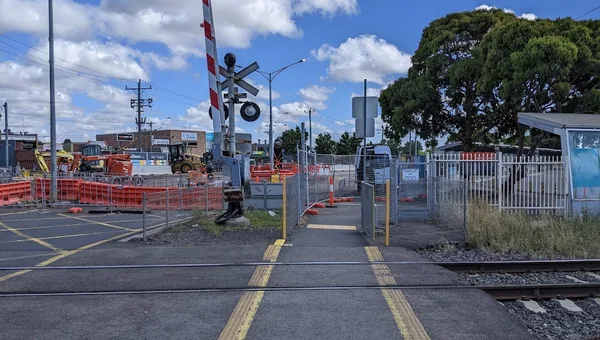
Hoppers Crossing has its own railway station on Metro Trains Melbourne's Werribee line, providing direct rail access into the Melbourne CBD. That infrastructure is a positive input to PropertyRanker's location-quality criteria, though the weight it carries depends on how close a specific listing is to the station. Investors should verify walkability to the station for any individual property, as Hoppers Crossing is a large suburb and access varies considerably by street.
Yes, PropertyRanker applies the postcode-level SEIFA reading to all 3029 listings, which means Hoppers Crossing, Truganina, and Tarneit properties all receive the same decile 6 input on economic_strength, hazard_risk, and entry_point_risk. In practice, the suburbs have different stock profiles: Hoppers Crossing is predominantly older detached housing with established services, while Truganina and Tarneit are newer master-planned estates. Those differences surface in the listing-level criteria rather than the SEIFA criteria, so comparing PropertyRanker scores across the three suburbs will reflect the stock and yield differences even though the SEIFA component is identical.
Paste a real address. Get a defensible verdict across 12 criteria in around three minutes.
Score a property free