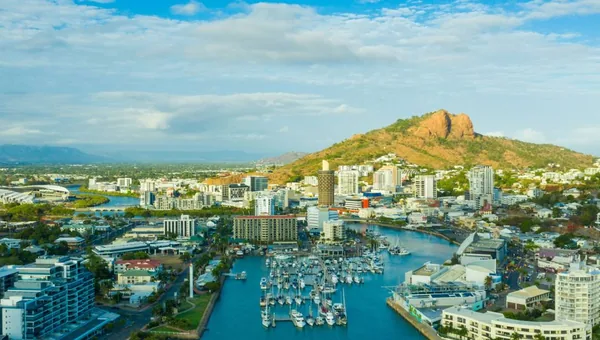
Townsville is the largest urban centre in northern Australia, 1,350 km north of Brisbane on the Coral Sea coast. The 4810 postcode covers the CBD, North Ward, South Townsville, Castle Hill, and West End, the dense pre-WWII urban core wrapped around the inner harbour.
ABS 2021 IRSAD release. Score 1013 (national mean = 1000).
Decile 7 is an advantaged reading, with the IRSAD score of 1013 sitting modestly above the national mean of 1000. State-percentile 77 places central Townsville comfortably in the top quartile of Queensland postcodes, the strongest signal coming out of the city's deep employment base. Three durable demand legs hold the market up. Defence is the largest, with Lavarack Barracks (5th Brigade) and RAAF Base Townsville together employing thousands. James Cook University and the Townsville University Hospital form an education-health cluster on the city's southern edge. The North West Mineral Province (Mt Isa, Cloncurry) and the Galilee Basin send fly-in fly-out workers through the airport. Townsville also sits at the southern end of the Great Barrier Reef visitor economy and the Townsville Stadium has brought consistent NRL crowds since opening. Capital growth has reaccelerated since the 2022 trough on the back of constrained supply and strong rental demand from the defence rotation and FIFO base. The 4810 postcode itself spans premium (Castle Hill, North Ward) through mid-tier (West End, South Townsville).
The City of Townsville LGA recorded a median house price of $700,000 in the first half of 2026, up approximately 9.4% on the 2025 annual median of $640,000, according to valuation firm Opteon. Propertyvalue.com.au reports 39 house sales in the past 12 months for the Townsville City suburb (postcode 4810) with an average vendor discount of -4.3% and average days on market of 37. The rental vacancy rate sits well below 1% (SQM Research via fpwgroup.com.au and keirconstructions.com.au), and days on market have been trending shorter, pointing to a hot and tightening market underpinned by strong infrastructure investment and population growth.
Anchor points pulled per refresh from publicly available suburb profiles. Approximate; not a moving average.
Vacancy is well below 1% and tightening relative to regional QLD averages, days on market are short and trending lower, and vendor discounts are modest at -4.3% in a strongly rising price environment, all three signals pointing to a hot market.
Sources: Townsville Residential Property Market Insights Half 1 2026 (2026-08-01); Townsville City House Prices & Property Trends (2026-09-01); Townsville Property Market: What Investors Need to Know Before Buying (2026-08-15); Townsville Real Estate 2026: Price Growth, Rental Yields & Buyer Demand (2026-02-01); Townsville Real Estate Market 2023 Update (2023-06-01) · Refreshed 5 Oct 2026
Townsville's property story over the past year is dominated by state and council efforts to unlock housing supply against a backdrop of very tight rental conditions, alongside a large industrial and infrastructure investment pipeline centred on the Lansdown precinct, CopperString and the Port of Townsville expansion. Council has also moved to actively court large developer-led projects with a new incentives policy, while road and active transport works are being funded to support growth in the city's northern and central suburbs. These drivers span the City of Townsville LGA rather than any single suburb.
The Queensland Government is turning a 4.5 hectare site next to the former Pimlico TAFE into a residential development expected to deliver up to 150 homes, with demolition underway and land release to market scheduled for mid 2026.
Nation-leading initiative unlocks surplus Townsville land for housing (2026-02-03)
State funding of $14.7 million through the Residential Activation Fund is supporting an intersection upgrade between Woolcock Street and Weston Street, described as delivering road infrastructure needed to facilitate new residential development in Townsville's fast-growing northern suburbs.
Works progressing to unlock housing supply in Townsville (2026-04-01)
Townsville City Council has introduced a policy offering infrastructure charge waivers, rate concessions and cash contributions to developer-led projects worth more than $5 million that begin construction before mid-2029, aimed at converting investor interest into built projects.
Townsville targets transformational projects under new policy (2026-06-01)
The 2,200 hectare Lansdown precinct near Townsville, declared a Prescribed Project, is attracting proponents such as Queensland Pacific Metals and High Purity Quartz for advanced manufacturing, while the multibillion-dollar CopperString transmission project is expected to underpin future power supply and employment across the region.
Lansdown Eco-Industrial Precinct, Office of the Coordinator-General
Following completion of the $251 million Channel Upgrade in 2025, Townsville Enterprise has called for $450 million in federal funding for the next stage of a $1.6 billion Port Expansion Project that could be delivered between 2026 and 2030, supporting the city's trade and logistics economy.
Port of Townsville Upgrade 2026 (2026-02-03)
Vacancy rates across Townsville have been reported as low as 0.6 to 0.9 per cent in late 2025 and early 2026, with rents rising strongly over the preceding 12 months amid limited new housing supply relative to population growth.
Regional Markets Outpacing Capitals - Townsville Leads the Way (2025-09-15)
Updated 4 Jul 2026. Items link to their original sources. Compiled by AI from public reporting; verify anything material before relying on it.
PropertyRanker scores any Australian property against 12 criteria across three pillars: Growth, Cashflow, and Risk. SEIFA is a primary signal for economic strength and a supporting one for entry-price risk. It also informs the crime side of hazard risk, though physical overlays like flood, bushfire and coastal exposure, and recorded crime data where available, take priority there. The decile of 7 shown above gives a listing in Townsville a stronger starting line on economic strength than the national median postcode, and a softer one on entry-price risk, since more advantaged postcodes usually carry higher entry prices.
On top of that, PropertyRanker chooses one of four strategies (Balanced, Growth, Yield, Regional) and applies a per-strategy yield anchor. The anchors are 3.5% for Growth, 5% for Balanced, 6% for Yield, and 7% for Regional. A postcode at this level of relative advantage tends to suit the Growth (3.5% anchor) and Balanced (5% anchor) strategies more readily than Yield (6%) or Regional (7%), because a higher entry price compresses the gross yield a listing can reach without a specific value-add.
Read the scoring guide for the full criteria list and how the verdict thresholds work.
Townsville's 4810 mixes four very different micro-markets within the same postcode. North Ward and The Strand carry heritage character overlay and tropical-style restrictions. Castle Hill is the premium hilltop where the steepness of the lot matters more than the SEIFA decile. South Townsville and parts of West End sit close to the port and have residual industrial-interface considerations. Cyclone exposure is the structural risk every Townsville investor must price. Verify the building's construction standard against the AS 4055 wind-rating zone (Townsville is Region C) and check insurance availability and excess specifically. Premiums in cyclone-rated markets can be materially higher than southern Queensland. Flood mapping is meaningful through the inner suburbs along Ross Creek and parts of South Townsville. Check the Townsville City Council flood overlay before scoring any low-set Queenslander. Defence-rotation tenancy demand can be lumpy, depending on posting cycles. Vacancy rates that look healthy on average can spike after rotation events.
The SEIFA IRSAD reading of 1013 places central Townsville above the national mean of 1000 and at the 77th percentile within Queensland, which PropertyRanker treats as a meaningful signal of economic strength and relatively lower entry-point risk. Three structurally durable demand drivers underpin the postcode: a large defence presence, a university and hospital cluster, and a fly-in fly-out base serving the North West Mineral Province. Whether a specific listing within 4810 translates that demand backdrop into adequate returns depends on the individual property score; the postcode spans premium pockets such as Castle Hill and North Ward through to mid-tier West End and South Townsville, so generalising across the whole postcode would not be analytically sound.
The Balanced strategy, which targets a gross yield anchor of around 5 percent, is the most consistent starting point for central Townsville, given the combination of a SEIFA decile 7 reading and the persistent rental demand generated by defence rotations through Lavarack Barracks and RAAF Base Townsville. The Capital Growth strategy at around 3.5 percent may suit premium Castle Hill or North Ward stock where land value is the primary thesis, while the High Yield strategy at around 6 percent is more relevant to lower-priced West End or South Townsville dwellings where the rent-to-price ratio is more favourable. Run the listing-level score on PropertyRanker to confirm which strategy the specific property's yield and risk profile actually supports.
Flood exposure is the most material hazard risk to verify at the individual property level. Townsville is built on the natural floodplains of the Ross and Bohle Rivers, and the 2019 monsoon event demonstrated that even areas outside formally mapped 1-percent AEP flood zones can be inundated under extreme conditions. Townsville City Council operates an online flood information portal where investors can check a specific address against current risk classifications before drawing any conclusions. Beyond flood, the postcode's demand is meaningfully tied to Commonwealth defence policy; any structural reduction in the Lavarack Barracks or RAAF Base Townsville workforce would affect rental absorption, so PropertyRanker weights that concentration risk inside its economic_strength criterion.
PropertyRanker feeds the SEIFA IRSAD reading into three of its twelve scoring criteria: economic_strength, hazard_risk, and entry_point_risk. A decile 7 score with a raw reading of 1013 produces a positive contribution to economic_strength, reflecting an employed and relatively advantaged resident base, and a modest reduction in entry_point_risk compared with lower-decile postcodes. The hazard_risk criterion uses SEIFA as one input alongside physical hazard overlays, so the SEIFA advantage here does not override the need to verify flood classification at the property level. All twelve criteria are then combined into the overall PropertyRanker score shown on the listing page.
Townsville is designated as Australia's Army Capital, with Lavarack Barracks home to the 3rd Brigade and multiple associated units, and an expansion of ADF personnel numbers has been flagged under ongoing defence restructuring. That institutional scale creates a relatively consistent rotation of tenants who typically require unfurnished residential stock close to the base, which tends to support rental occupancy. The concentration in a single employer sector is also a risk that PropertyRanker captures explicitly; a policy shift, a force restructure, or a change in housing allowance settings could affect demand faster than a diversified economic base would. Investors should score the specific listing and review current vacancy data for the relevant pocket of 4810 rather than assuming postcode-level demand applies uniformly.
Paste a real address. Get a defensible verdict across 12 criteria in around three minutes.
Score a property free