Pimpama sits in the Gold Coast's northern growth corridor at postcode 4209, between the M1 and the Coomera River. It scores a SEIFA IRSAD decile of 6, sitting in the 66th state percentile within Queensland for relative advantage.
ABS 2021 IRSAD release. Score 986 (national mean = 1000).
A SEIFA decile of 6 is a mid-band reading, slightly above the national mean of 1000 at a raw score of 986. For a postcode that was largely greenfield development a decade ago, that profile is consistent with a population still settling into a young, family-skewed demographic mix rather than the long-established economic base you see in the inner Gold Coast. PropertyRanker uses SEIFA as a primary signal for economic_strength, hazard_risk, and entry_point_risk. A decile 6 reading puts Pimpama somewhere near the middle of the model on those three criteria, neither tilting the score up like a top-decile postcode would nor dragging it down. The signal that tends to move scores in 4209 is the strategy choice. Pimpama's combination of newer stock, family migration, and proximity to a major motorway is a fair fit for a Growth or Balanced strategy, where the yield anchor is more forgiving. On a Yield strategy, where the anchor is 6% gross, the same listing has to work harder. None of that says Pimpama is right or wrong for an investor. It says the SEIFA reading is doing only part of the work, and the rest depends on what the listing itself offers and which strategy the buyer is running.
Pimpama's house market is recording strong momentum heading into late 2026, with propertyvalue.com.au reporting a median sale price of $955,000 and 15.8% annual growth over the 12 months to early 2026, while andreamonti.com.au places the August 2026 median at $1,044,750 with 17.4% annual growth and 487 houses sold in the year to July 2026. Vendor discounting is minimal at -3.8% and average days on market sit at just 15 days, pointing to strong buyer competition, while the suburb vacancy rate of approximately 1.0-1.8% (htag.com.au, andreamonti.com.au) confirms a tight rental market underpinning continued price support.
Anchor points pulled per refresh from publicly available suburb profiles. Approximate; not a moving average.
All three signals are favourable: vacancy is tight at 1.0-1.8%, average days on market is just 15 days, and vendor discounting is a slim -3.8%, together indicating a hot market with strong buyer competition.
Sources: Pimpama House Prices & Property Trends (2026-02-01); Pimpama, QLD 4209: Suburb Profile & Property Report (2026-02-01); PIMPAMA, QLD Median House Price $1,044,750 (2026-08-01); Pimpama, QLD 4209 Property Market and House Prices 2026 (2026-01-01); House prices in Pimpama Gold Coast (C), 4209 QLD (2021-12-15) · Refreshed 4 Oct 2026
PropertyRanker scores any Australian property against 12 criteria across three pillars: Growth, Cashflow, and Risk. SEIFA is a primary signal for economic strength and a supporting one for entry-price risk. It also informs the crime side of hazard risk, though physical overlays like flood, bushfire and coastal exposure, and recorded crime data where available, take priority there. The decile of 6 shown above gives a listing in Pimpama a stronger starting line on economic strength than the national median postcode, and a softer one on entry-price risk, since more advantaged postcodes usually carry higher entry prices.
On top of that, PropertyRanker chooses one of four strategies (Balanced, Growth, Yield, Regional) and applies a per-strategy yield anchor. The anchors are 3.5% for Growth, 5% for Balanced, 6% for Yield, and 7% for Regional. A postcode at this level of relative advantage tends to suit the Growth (3.5% anchor) and Balanced (5% anchor) strategies more readily than Yield (6%) or Regional (7%), because a higher entry price compresses the gross yield a listing can reach without a specific value-add.
Read the scoring guide for the full criteria list and how the verdict thresholds work.
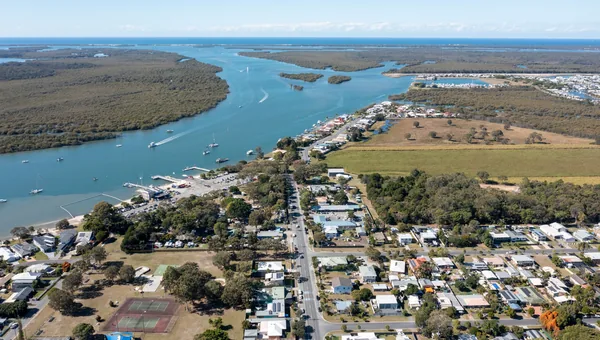
SEIFA is a postcode-level read. The fastest sanity check on any single decile reading is to compare it against the suburbs that surround it.
SEIFA is a postcode-level read and Pimpama is one of several growing localities inside 4209. A static suburb page cannot see the difference between an estate built five years ago and one mid-construction now, or the difference between a corner block near a future train station and a courtyard home backing a stormwater easement. The Gold Coast's flood and overlay maps, the Coomera connector road sequencing, and the body corporate health for any townhouse purchase all sit outside what a decile signal will tell you. Score the specific listing before drawing a conclusion about the deal.
A SEIFA IRSAD decile of 6 and a raw score of 986 put Pimpama in the mid band, sitting at the 66th state percentile within Queensland. That reading is neither a strong advantage signal nor a drag on the PropertyRanker score; it reflects a postcode still maturing from greenfield development rather than one with a settled, deep economic base. What the data suggests is that Pimpama warrants closer scrutiny of the individual listing, the strategy chosen, and local demand fundamentals rather than a simple yes or no from the SEIFA reading alone.
The analysis points to Capital Growth (anchored around 3.5 percent gross yield) or Balanced (anchored around 5 percent) as the strategies where Pimpama's profile is most workable. Newer housing stock, a family-oriented migrant population, M1 motorway access, and a newly opened train station on the Gold Coast line are the kinds of locational inputs that tend to sit more comfortably with a growth or balanced yield anchor. A High Yield or Regional strategy, where the gross yield anchor climbs to 6 or 7 percent, demands more from the listing itself; score the specific property on PropertyRanker to see whether it clears that bar.
PropertyRanker uses SEIFA as a primary signal for hazard_risk, and Pimpama's position beside the Coomera and Pimpama rivers is a material factor to verify: Bureau of Meteorology records show the Pimpama River catchment has reached major flood levels during heavy rainfall events. A mid-band SEIFA reading also means entry_point_risk sits in the middle of the model, so overpaying relative to the economic base of the area is a genuine concern. Investors should check the Gold Coast City Council flood overlay and confirm flood insurance costs for any specific property before drawing conclusions.
Pimpama station opened on the Gold Coast heavy rail line in October 2025 as part of the Cross River Rail project, giving the suburb its first direct rail connection. Proximity to a rail station is factored into PropertyRanker's infrastructure and demand inputs, so listings closer to the station precinct may score differently from those further away in the same postcode. Score the specific address rather than assuming all of 4209 benefits equally from the infrastructure.
PropertyRanker runs twelve scoring criteria across four strategies; SEIFA IRSAD feeds directly into three of them (economic_strength, hazard_risk, and entry_point_risk) using Pimpama's decile 6 reading and raw score of 986. The remaining criteria draw on listing-level inputs such as asking price, estimated gross yield, and property characteristics, which vary by address. Because mid-band SEIFA scores like Pimpama's do only part of the scoring work, the strategy you select and the numbers in the listing itself carry significant weight in the final score.
Paste a real address. Get a defensible verdict across 12 criteria in around three minutes.
Score a property free